


Schuylkill Township
William Moore

.jpg)
As a young boy, William Moore (1699-1783) was sent to England to be educated. A decade after graduating from the University of Oxford in 1719, his father John gave him a lot of 240 acres on the Pickering Creek in Charlestown Township in Chester County, PA. There, William built an estate that became known as Moore Hall. He also built a sawmill and the Bull Tavern. He joined the military and became a colonel of one of the Chester County militia regiments during the Indian conflict. He was appointed a judge but when the Revolution broke out, he sided with the British crown.
Elijah Funk Pennypacker
Elijah Funk Pennypacker was born near Phoenixville where he was engaged in land surveying. He was elected to the PA House of Representatives, and was in office from 1831-1838. Not only he was vocal in support of public schools, he was also actively opposed to slavery. He became president of the local, Chester County's, and the state's anti-slavery society. His White Horse Farm was used as a underground railroad stop during the 1840s.

Charles Moore Wheatley's Discoveries
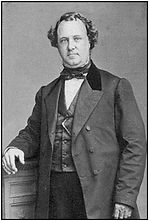

Charles Moore Wheatley was born in England, and migrated to New York with his father. At a young age, he was fascinated by scientific discoveries, and one day brought home a box of a beautiful and perfect specimens of Pandora trilineata found deep in the New York harbor. This prompted him to study conchology and mineralogy. But then he pursued copper mine exploration. He discovered lead and copper in Phoenixville, PA between Nutt and Mine Roads. That lead to him establishing the Wheatley Silver Lead Mine where he was a general manager from 1850 to 1857. He kept a collection of unique shells found in Phoenixville that earned him a silver medal from the 1855 World Exhibition in Paris and a bronze medal from the 1876 Centennial Exhibition in Philadelphia.
The MacVeagh Brothers Move Up
Wayne and Franklin MacVeagh grew up in Phoenixville and graduated from Yale. Franklin would become a merchant in Chicago en route to becoming President Taft’s Treasury Secretary. His brother Wayne would serve as Chester County district attorney and then start the Philadelphia law firm Dechert, Price and Rhoads in 1875, one of America’s largest law firms. Wayne would serve as Attorney General to Presidents Garfield and Arthur.


Uriah Galusha Pennypacker, the Civil War's Youngest General


Uriah Galusha Pennypacker was born in Valley Forge in Schuylkill Township. His mother died shortly after his birth and his father abandoned him to serve in Mexico. He later became a newspaperman in West Chester and gold prospector in California. In August, 1861 Galusha joined the 97th Pennsylvania Infantry, a unit organized in West Chester. Depending on his date of birth he was between 17 and 20 years old at the time. His family’s prominence played a major role in rank so Galusha started his career as a captain. Before joining the army, he was appointed to a cadetship at the West Point Military Academy through his uncle. After training at Camp Wayne near West Chester, the 97th travelled to Fort Monroe outside Washington and then by ship to the sea islands along the coast of South Carolina. Their most famous engagement in the South was the assault on Fort Wagner which took place about two weeks after the Battle of Gettysburg. The Fort Wagner assault is portrayed in the 1989 movie "Glory."
The 97th would later be sent to Jacksonville, Florida before being returned to the upper South where it saw service in battles at Bermuda Hundred and New Market, Virginia. Pennypacker was wounded several times but during an engagement at Fort Fisher outside Wilmington N.C. in January 1865 he was so severely wounded that he was expected to die. He would later be awarded the Medal of Honor for his refusal to retreat or strike colors in the face of intense enemy fire. It took 10 months to recover from those wounds but in April 1865 he was promoted to brigadier general; the youngest officer to be appointed to such a high position in the history of the U.S. military. He remained in the service after the war and retired in 1883. He is referenced in Ulysses Grant’s memoirs.
Bibliography
"Brig. General John Forbes." Clan Forbes Society. Accessed March 1, 2025. https://www.clan-forbes.org/people/brig.-general-john-forbes.
Encyclopaedia of Contemporary Biography, of Pennsylvania, Volume 3. (New York: Atlantic Publishing & Engraving Company, 1898): 226-228.
"Majolica." The Historical Society of the Phoenixville. Accessed March 16, 2025. https://hspa-pa.org/majolica/#elementor-toc__heading-anchor-2.
Moon, Robert Charles. The Morris Family of Philadelphia, Descendants of Anthony Morris, 1654-1721, Volume 2. (Philadelphia: R. C. Moon, 1898): 744-746.
"Museum of Classic Pennsylvania Minerals!" Penn Minerals. Accessed July 14, 2025. https://pennminerals.com/museum.
The National Cyclopaedia of American Biography, Being the History of the United States as Illustrated in the Lives of the Founders, Builders, and Defenders of the Republic, and of the Men and Women who are Doing the Work and Moulding the Thought of the Present Time, Volume 14, Part 2. (New York: James T. White, 1910): 409-410.
Thomson, W.W. Chester County and Its People. (Chicago: The Union History Company, 1898): 322-324.
Wilson, James Grant and John Fiske. Appletons' Cyclopaedia of American Biography, Volume 4. (New York: D. Appleton and Company, 1888): 719.